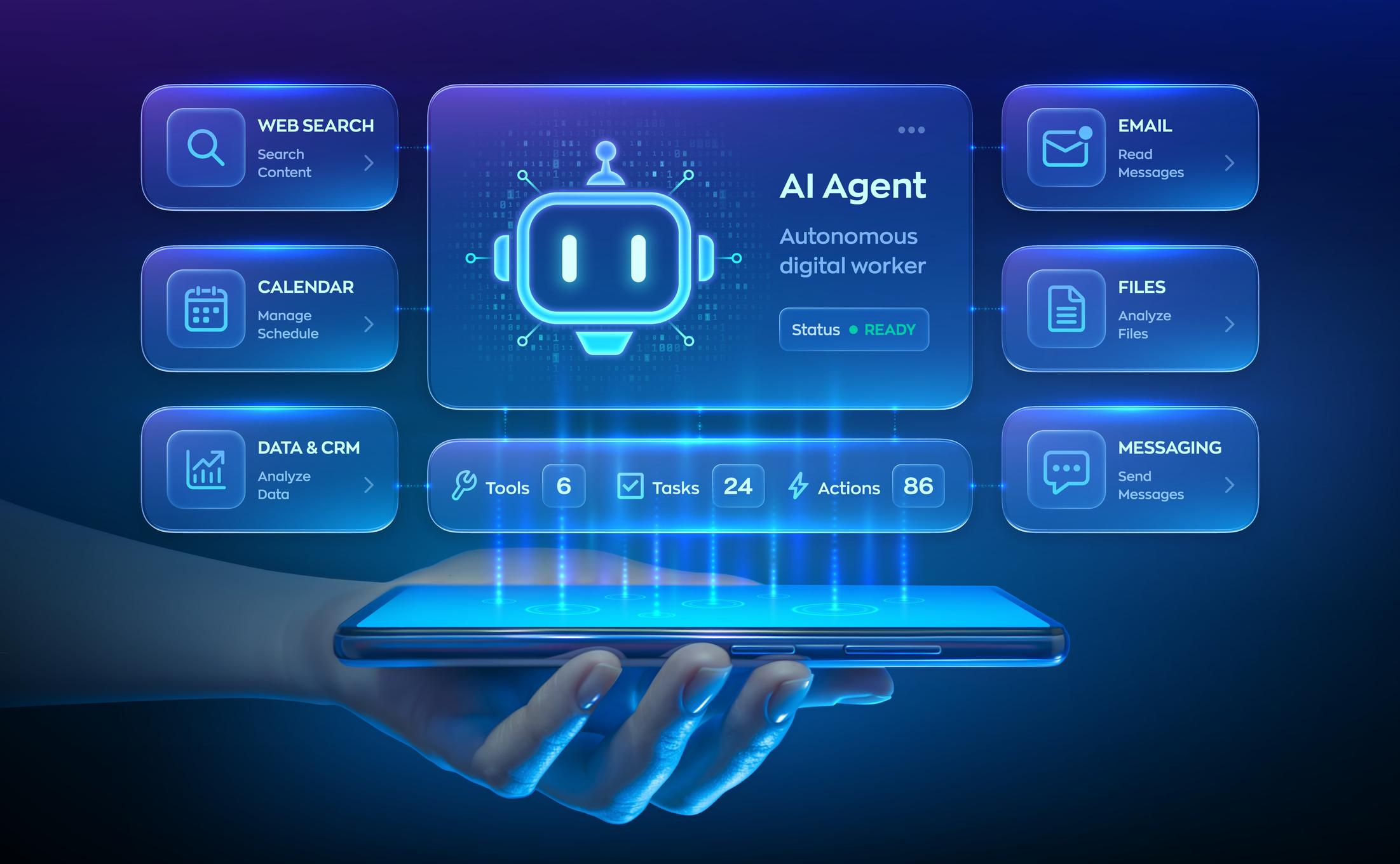
Imagine giving your computer a task like researching potential customers, comparing their requirements, preparing a report and organising the results in a spreadsheet. Instead of asking you to complete every step, an AI system plans the work, uses different tools and carries out the individual tasks with limited supervision.
This is the idea behind AI agents.
Artificial Intelligence has already changed how people write, research, communicate and create content. But the next development is moving beyond AI systems that simply answer questions. AI agents are designed to take action, complete multi-step tasks and work towards specific goals.
You may have heard terms such as AI agents, agentic AI and AI automation in recent technology discussions. Businesses are exploring these technologies to improve productivity, while developers are building applications that can perform increasingly complex tasks.
But what exactly are AI agents? Are they different from ChatGPT and Claude? Can an ordinary person use them? And will they change the way businesses operate?
Let’s understand this technology through simple explanations and practical examples.
What Are AI Agents?
AI agents are software systems that use artificial intelligence to understand a goal, plan the steps required and perform actions using available tools.
In simple words, an AI agent is like a digital assistant that can do more than answer your questions. It can also work through a task on your behalf.
For example, imagine asking a normal chatbot:
“Find five potential customers for my digital marketing agency.”
It might suggest ways to identify customers or explain how to research businesses.
An AI agent with suitable tools and permissions could take the process further:
- Search for businesses in a selected industry.
- Visit their publicly available websites.
- Identify relevant business information.
- Organise the findings.
- Prepare a structured lead-generation report.
The important difference is that the agent can perform actions rather than simply describing what you should do.
According to Google Cloud, AI agents use capabilities such as reasoning, planning, memory and tool access to pursue goals and complete tasks. The level of independence depends on how the agent is designed.
What Is the Difference Between an AI Agent and a Chatbot?
This is one of the most common questions people have when learning about agentic AI.
A traditional chatbot mainly responds to questions and instructions. An AI agent can use tools and execute multiple steps to accomplish a particular objective.
Consider this example:
A traditional chatbot:
You ask, “How can I organise my business expenses?”
It explains how to create an expense tracker and categorise your spending.
An AI agent:
You provide an expense spreadsheet and give it permission to work with the file. It analyses the data, identifies categories, calculates totals and prepares a report.
The distinction is not always absolute. Modern AI assistants can also use tools, analyse files and perform actions. Some are effectively agentic systems for particular tasks.
The key difference is the workflow: an agent is designed to pursue a goal through a sequence of decisions and actions.
How Do AI Agents Work?
AI agents generally combine an AI model with instructions, tools, information sources and mechanisms for controlling their actions.
Although different systems have different architectures, most follow a similar process.
1. Understanding the Goal
The first step is understanding what the user wants.
For example:
“Research five AI tools suitable for a small digital marketing agency and prepare a comparison report.”
The agent interprets the objective and identifies what needs to be accomplished.
2. Planning the Tasks
The agent breaks the larger objective into smaller steps.
It may decide that it needs to:
- Identify suitable AI tools.
- Visit their official websites.
- Research available features.
- Compare pricing and free plans.
- Prepare a comparison table.
This planning stage helps the system organise complicated tasks.
3. Using Tools
An AI model alone cannot perform every real-world action. It needs access to appropriate tools.
These may include:
- Web search.
- File readers.
- Spreadsheets.
- Databases.
- APIs.
- Email systems.
- Business applications.
For example, an agent with authorised spreadsheet access can read data and prepare a report.
4. Observing the Results
After performing an action, the agent checks what happened.
If a website does not load or a search does not return useful results, the system may need to change its approach.
5. Repeating the Process
The agent continues planning, acting and evaluating results until it completes the task, reaches a stopping condition or requires human assistance.
This is sometimes called an agent loop.
6. Delivering the Final Output
Once the task is completed, the agent provides the result.
Depending on its permissions, this might be a report, spreadsheet, completed research task or updated business record.
Not every agent has all these capabilities. Its performance depends on the model, tools, permissions and safeguards provided to it.
What Are the Different Types of AI Agents?
AI agents can be classified in several ways. For beginners, it is useful to understand them according to their purpose and level of complexity.
1. Personal AI Agents
Personal AI agents are designed to help individuals organise their work and everyday activities.
They may assist with scheduling, reminders, research, information management and other productivity tasks.
For example, an assistant could help organise your weekly schedule using information from an authorised calendar.
2. Customer Support Agents
Businesses can use AI agents to respond to customer queries, retrieve order information and assist with common service requests.
For example, an online shopping business could deploy an agent that checks order status and provides delivery information.
For sensitive issues, the system should transfer the conversation to a human representative.
3. Research Agents
Research agents can gather information from multiple sources, organise findings and prepare structured reports.
They are particularly useful for market research, competitor analysis and technical research.
However, the sources and findings must be verified before important decisions are made.
4. Coding Agents
Coding agents help developers work with software projects.
They can analyse code, identify errors, suggest modifications and assist with development workflows.
These systems are particularly useful for programmers working on large or complicated projects.
5. Business Automation Agents
Business agents can help automate repetitive workflows involving documents, customer information, internal systems and communication.
For example, an agent could review incoming enquiries, categorise them and prepare draft responses.
6. Multi-Agent Systems
Some complex applications use multiple specialised agents working together.
Imagine a digital marketing workflow with three agents:
- A research agent identifies relevant topics and competitors.
- A content agent prepares article drafts.
- An SEO agent reviews keywords, headings and internal linking opportunities.
A coordinating system can manage the work between these agents.
Multi-agent systems can be useful for complicated projects, although adding more agents does not automatically improve results.
10 Practical Uses of AI Agents in Everyday Work
AI agents are not limited to large technology companies. Their applications can extend to small businesses, educational institutions, freelancers and individual professionals.
Here are ten practical examples.
1. Automating Email Management
An email agent could categorise incoming messages, identify urgent enquiries and prepare draft responses.
A human can review and approve important messages before they are sent.
2. Researching Competitors
A business research agent could visit publicly accessible competitor websites, collect product information and organise comparisons.
This can reduce the time spent gathering information manually.
3. Managing Customer Enquiries
A customer service agent can answer frequently asked questions, retrieve authorised information and direct complicated requests to the appropriate department.
4. Generating Business Reports
An agent connected to authorised business data could analyse sales information, identify patterns and prepare reports.
This is useful for businesses that regularly work with spreadsheets and databases.
5. Planning Social Media Content
A content planning agent could research relevant topics, prepare a posting calendar and draft captions for different social media platforms.
Human review remains important for brand consistency and factual accuracy.
6. Supporting Online Stores
E-commerce agents can assist with product discovery, customer enquiries, order information and inventory-related workflows.
The actions they can perform depend on the systems and permissions connected to them.
7. Assisting Students
Educational agents could organise learning material, prepare practice questions and help students follow a study schedule.
They should support learning rather than replace independent thinking.
8. Supporting Software Development
Coding agents can assist developers with understanding unfamiliar code, fixing errors and preparing software changes.
All generated code should be tested before deployment.
9. Automating Administrative Work
An agent could organise documents, extract information from supported files and prepare routine administrative reports.
This can be particularly valuable in organisations where employees spend considerable time on repetitive documentation.
10. Managing Digital Marketing Workflows
A marketing agent could help with keyword research, competitor monitoring, content planning and campaign reporting.
For example, it could identify topics relevant to a business, prepare a content calendar and organise performance data.
Best AI Agent Tools and Platforms to Explore in 2026
If you want to understand or experiment with AI agents, several platforms provide useful starting points.
1. OpenAI Agent Tools
Website: https://platform.openai.com/
OpenAI provides developer tools for building AI agents that can use tools, follow instructions and perform multi-step workflows.
The Agents SDK and related APIs are intended for developers building more advanced applications.
Best for: Developers and businesses building customised AI applications.
2. Claude and Claude Code
Website: https://claude.ai/
Anthropic offers AI capabilities that can support complex workflows, coding and tool use.
Claude Code is a specialised coding tool designed to help developers work with software projects.
Best for: Software developers, technical teams and professionals exploring AI-assisted workflows.
3. Google AI Studio
Website: https://aistudio.google.com/
Google AI Studio allows developers and technology enthusiasts to experiment with Gemini models and build AI-powered prototypes.
It can be used as a starting point for exploring applications that combine language models with external tools.
Best for: Beginners exploring AI development and developers building prototypes.
4. n8n
Website: https://n8n.io/
n8n is a workflow automation platform that supports AI-powered workflows and integrations.
Users can connect different services and create automated processes. It is useful for people who want to combine AI with existing business applications.
Best for: Entrepreneurs, automation specialists and technical teams.
5. Zapier
Website: https://zapier.com/
Zapier connects different applications and automates repetitive tasks. Its AI capabilities and agent-related features can help users build workflows across supported services.
Best for: Small businesses and professionals looking to automate routine work.
6. Microsoft Copilot Studio
Website: https://www.microsoft.com/en-us/microsoft-copilot/microsoft-copilot-studio
Microsoft Copilot Studio helps organisations build and manage AI agents that can work with business information and connected systems.
Best for: Businesses already using Microsoft products and enterprise applications.
Important: These platforms do not all serve the same purpose. Some provide developer frameworks, while others focus on workflow automation or enterprise agent creation. Availability, pricing and feature access vary.
What Is the Difference Between AI Automation and Agentic AI?
AI automation and agentic AI are related, but they are not identical.
Traditional automation generally follows predefined instructions.
For example, a workflow might automatically send an email whenever a customer submits a form.
Agentic AI can interpret more complicated situations and choose from available actions.
Imagine a customer sends a message explaining that their order has not arrived.
A traditional workflow might send a standard response.
An AI agent could interpret the message, check the authorised order system, identify the delivery status and prepare an appropriate response.
In simple terms:
- Traditional automation follows predefined rules.
- AI assistants respond to user instructions.
- AI agents can plan and execute multi-step tasks using tools.
Many modern systems combine all three approaches.
Benefits of AI Agents for Businesses
Businesses are exploring AI agents because they can help improve operational efficiency.
1. Reduced Repetitive Work
Agents can handle certain routine activities, allowing employees to focus on tasks requiring human judgement.
2. Faster Workflows
Multi-step tasks that involve collecting and organising information may become faster when suitable processes are automated.
3. Better Availability
Customer-facing agents can provide assistance outside normal working hours, subject to their capabilities and operating conditions.
4. Improved Information Management
Agents can help organise data from multiple sources and prepare structured reports.
5. Scalable Operations
Businesses may use agents to handle increasing volumes of routine requests without having to increase every administrative task manually.
However, the actual savings depend on implementation costs, accuracy, maintenance and the need for human supervision.
Risks and Limitations of AI Agents
AI agents offer exciting possibilities, but giving an AI system the ability to take action introduces additional risks.
1. Incorrect Decisions
An agent may misunderstand instructions or work with inaccurate information.
2. Data Privacy
Agents connected to email, customer databases and business systems may access sensitive information. Access should be limited to what is necessary.
3. Unauthorised Actions
A poorly configured agent could send incorrect messages, modify records or perform actions the user did not intend.
4. Security Threats
AI agents that interact with external content may be exposed to prompt injection and other security risks.
5. Financial Costs
Complex workflows may involve multiple model calls, external services and computing resources. These expenses can increase with usage.
6. Human Oversight
Important actions such as payments, deleting information, approving refunds or changing customer records should have appropriate safeguards and approval requirements.
The safest approach is to begin with low-risk tasks, monitor performance and gradually expand the agent’s responsibilities.
How Can Beginners Start Learning About AI Agents?
You do not need to build a complicated AI system on your first day.
Start by understanding how AI tools work and identifying tasks that could benefit from automation.
Here is a simple learning roadmap.
Step 1: Learn the fundamentals of AI
Understand artificial intelligence, machine learning, large language models and generative AI.
Step 2: Experiment with AI assistants
Explore ChatGPT, Claude and Gemini. Understand how they process instructions and use available tools.
Step 3: Learn basic workflow automation
Experiment with platforms such as n8n or Zapier to connect applications and automate repetitive tasks.
Step 4: Understand APIs and integrations
Learn how software applications communicate with one another. Basic knowledge of APIs becomes valuable when building more advanced agents.
Step 5: Build a small project
Start with something practical, such as a research assistant, document organiser or customer enquiry classifier.
Step 6: Add safeguards
Set clear permissions, test different scenarios and require human approval for sensitive actions.
Learning through small projects is often more effective than trying to understand every advanced concept at once.
Will AI Agents Replace Human Jobs?
The growing use of AI agents naturally raises concerns about employment.
Some repetitive tasks may become increasingly automated. Jobs involving routine data processing, basic customer support and repetitive administrative work could experience significant changes.
However, this does not mean every job will disappear.
Businesses still need people who can understand customers, make responsible decisions, manage relationships, solve unusual problems and take accountability.
In fact, AI adoption may increase demand for skills such as:
- AI workflow design.
- Automation development.
- Data analysis.
- AI security and governance.
- Critical thinking.
- Communication and problem-solving.
The more useful question may not be whether AI agents will replace humans, but how people can learn to work effectively alongside them.
Frequently Asked Questions About AI Agents
1. What is an AI agent in simple words?
An AI agent is a software system that uses artificial intelligence to understand a goal, plan tasks and perform actions using available tools.
2. Is ChatGPT an AI agent?
ChatGPT is primarily known as an AI assistant, but it can also perform agent-like workflows when equipped with tools and the ability to take actions. The distinction depends on the particular capabilities and workflow being used.
3. What is agentic AI?
Agentic AI refers to AI systems designed to pursue goals, make decisions, plan steps and perform actions with varying levels of independence.
4. Are AI agents free to use?
Some platforms provide free access or limited free usage for experimenting with AI agents. However, advanced features, API usage, integrations and business deployments may involve costs.
5. Can AI agents work without human supervision?
Some agents can perform defined tasks with limited supervision. However, high-risk activities and important decisions should involve appropriate human oversight.
6. Can small businesses use AI agents?
Yes. Small businesses can explore agents for customer support, research, document management, marketing and administrative workflows.
7. What skills are needed to build AI agents?
Basic programming, API knowledge, prompt design, workflow automation and an understanding of AI models are useful. No-code platforms also provide entry points for beginners.
8. What is the difference between an AI chatbot and an AI agent?
A chatbot primarily responds to conversations. An AI agent can use tools, plan multiple steps and perform actions to achieve a goal.
Final Thoughts
AI agents represent an important development in the evolution of artificial intelligence.
For years, people have used computers to perform individual tasks. Generative AI made it easier to communicate with machines using natural language. AI agents take this interaction further by allowing systems to work through multiple steps and complete defined objectives.
For a student, this could mean having an assistant that organises learning material. For a business owner, it could mean automating routine customer enquiries. For a developer, it could mean building software that can research, analyse and execute tasks.
However, greater autonomy also brings greater responsibility. AI agents need clear instructions, limited permissions, proper testing and human oversight.
You do not need to become an AI engineer to understand this technology. Start by exploring practical applications and learning where automation can genuinely improve your work.
The future of AI may not be limited to machines that answer our questions. It may increasingly involve systems that help us get things done.
Stay informed, stay curious and discover the future of technology with Rozana Updates.
Tags: AI Agents, What Are AI Agents, Agentic AI, AI Automation, Autonomous AI Agents, Artificial Intelligence, AI Tools 2026, AI Agents for Business, AI Productivity, AI Workflows, OpenAI Agents, Claude AI, Google AI, n8n Automation, Zapier AI, Business Automation, Future of Artificial Intelligence, AI Technology