Artificial Intelligence, commonly known as AI, is one of the most talked-about technologies in the world today. From asking questions on ChatGPT to getting directions through Google Maps, artificial intelligence has gradually become part of our everyday lives. It is changing how people work, learn, communicate, shop and run businesses.
But what exactly is artificial intelligence? How does it work? Can machines really think like humans? And why are companies around the world investing so heavily in AI?
If you are new to this technology, understanding artificial intelligence does not have to be complicated. In this beginner-friendly guide, we will explain the meaning of AI, how it works, its different types, real-world applications, advantages, limitations and what its future could look like.
What Is Artificial Intelligence (AI)?
Artificial Intelligence is a branch of computer science that focuses on developing machines and computer systems capable of performing tasks that normally require human intelligence.
These tasks include learning from information, recognising patterns, understanding language, solving problems, making predictions and generating new content.
In simple words, artificial intelligence enables computers to perform certain tasks that we traditionally associate with human thinking and decision-making.
For example:
- Google Maps uses AI-related technologies to estimate travel times and suggest routes.
- ChatGPT answers questions, explains concepts and helps users write content.
- Smartphone cameras use AI techniques to improve photographs.
- Online shopping platforms recommend products based on user behaviour.
- Email services identify potentially unwanted or fraudulent messages.
These examples demonstrate that AI is not limited to robots or advanced research laboratories. It is already being used in applications that millions of people interact with every day.
How Does Artificial Intelligence Work?
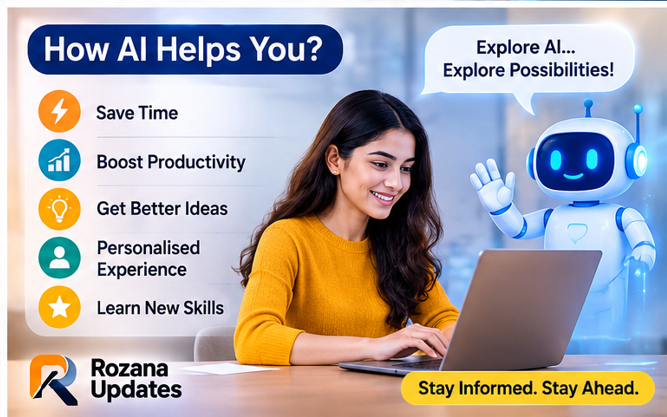
Artificial intelligence works by processing information, identifying patterns and using those patterns to generate predictions, recommendations or responses.
The exact process depends on the type of AI system being used. However, most modern AI applications involve a combination of data, algorithms, computing power and trained models.
Here is a simplified explanation of how it works.
1. Data Collection
AI systems need information to learn patterns and perform tasks. This information may include text, images, videos, audio recordings, numbers or other forms of data.
For example, an AI system designed to recognise different types of vehicles may be trained using thousands of vehicle photographs.
2. Data Processing
The collected information is processed and organised so that the system can identify useful patterns.
Poor-quality or irrelevant data can affect the accuracy of an AI system.
3. Model Training
During training, an AI model learns patterns from examples using mathematical techniques and algorithms.
For example, a language model learns statistical relationships between words and other elements of language by processing large amounts of text.
4. Making Predictions or Generating Results
Once trained, the model can receive new information and produce an output.
This output might be a prediction, recommendation, classification, answer, image or another type of generated content.
5. Evaluation and Improvement
AI systems are evaluated to understand how accurately and reliably they perform. Developers may improve them using additional training, better data, testing and feedback.
Example: Imagine an AI-powered email filter. It analyses patterns in incoming emails and estimates whether a message is legitimate or potentially spam. It then helps organise your inbox accordingly.
What Are the Different Types of Artificial Intelligence?
Artificial intelligence can be classified in different ways. One common approach classifies AI according to its capabilities.
1. Narrow AI (Weak AI)
Narrow AI refers to artificial intelligence designed to perform specific tasks or a limited range of tasks.
Most AI systems available today fall into this category.
Examples include:
- Voice assistants.
- Facial recognition systems.
- Recommendation engines.
- AI-powered translation tools.
- Chatbots designed for customer support.
Although some narrow AI systems can perform their assigned tasks extremely well, they do not possess general human-like intelligence.
2. Artificial General Intelligence (AGI)
Artificial General Intelligence refers to a hypothetical form of AI that could understand, learn and perform a broad range of intellectual tasks at a human-like level.
Unlike narrow AI, AGI would not be restricted to a particular task.
AGI remains an unsolved research goal. Today’s advanced AI assistants should not automatically be considered AGI simply because they can perform many different tasks.
3. Artificial Superintelligence (ASI)
Artificial Superintelligence is a theoretical concept describing an AI system that would significantly surpass human intellectual capabilities across a wide range of areas.
It is frequently discussed in debates about the long-term future of artificial intelligence.
ASI does not currently exist as an established real-world technology.
What Are Machine Learning, Deep Learning and Generative AI?
You may have come across terms such as Machine Learning, Deep Learning and Generative AI while reading about artificial intelligence.
Although these terms are related, they do not mean exactly the same thing.
Machine Learning (ML)
Machine Learning is a branch of AI that allows computer systems to learn patterns from data and make predictions or decisions without requiring developers to manually program every individual rule.
For example, an online shopping platform can use machine learning to recommend products based on previous purchases, searches and browsing behaviour.
Deep Learning
Deep Learning is a specialised area of machine learning that uses artificial neural networks with multiple layers to identify complex patterns.
It is widely used in image recognition, speech processing, language technologies and other advanced AI applications.
For example, deep learning can help a computer system recognise objects in photographs or understand spoken language.
Generative AI
Generative AI refers to AI systems capable of creating new content based on patterns learned during training.
Depending on the model, this content may include:
- Written articles and stories.
- Images and illustrations.
- Computer code.
- Audio and music.
- Videos.
- Summaries and explanations.
Popular examples include ChatGPT, Claude, Google Gemini and image-generation platforms.
Generative AI has made artificial intelligence more accessible because people can interact with these systems using ordinary language instead of requiring advanced programming knowledge.
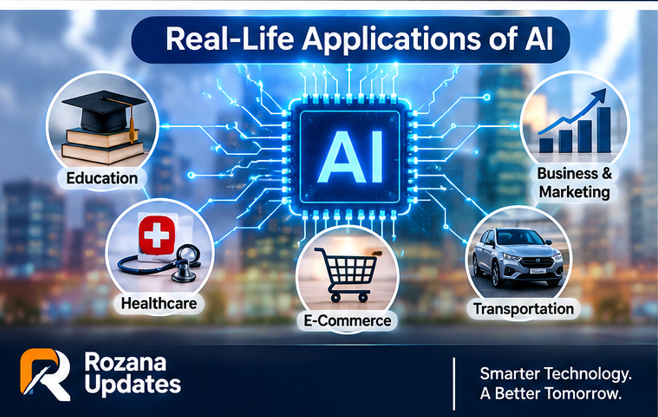
Real-Life Applications of Artificial Intelligence
Artificial intelligence is being used across different industries. Here are some practical examples.
1. Education
AI can help students understand difficult subjects, practise languages, summarise study material and prepare for examinations.
Teachers can use AI to develop lesson plans, create educational activities and prepare practice questions.
However, students should use AI as a learning assistant rather than depending on it to complete every assignment.
2. Healthcare
AI technologies can assist healthcare professionals with medical image analysis, identifying patterns in patient data, research and administrative tasks.
These applications can support medical professionals, but AI-generated information should not replace qualified medical judgement.
3. Banking and Finance
Banks and financial institutions use AI-related technologies to detect suspicious transactions, assess certain financial risks, automate customer support and analyse financial information.
Fraud detection is an important example because computer systems can identify unusual transaction patterns for further investigation.
4. Digital Marketing
AI is changing how businesses create and manage marketing campaigns.
Digital marketers can use AI for:
- Keyword research and content planning.
- Customer behaviour analysis.
- Advertising optimisation.
- Social media content creation.
- Email marketing personalisation.
- Competitor research.
These tools can improve productivity, although human strategy and verification remain essential.
5. Transportation
Navigation applications use data and predictive technologies to estimate traffic conditions, calculate routes and provide arrival-time estimates.
AI is also being researched and applied in driver-assistance systems, autonomous vehicles and transportation management.
6. Manufacturing
Manufacturing companies use AI for quality inspection, predictive maintenance, production planning and analysing equipment performance.
These applications can help identify potential problems before they cause significant operational disruption.
What Are the Advantages of Artificial Intelligence?
Artificial intelligence offers several potential benefits when implemented responsibly.
1. Automation: AI can automate repetitive tasks, allowing people to focus on more complex activities.
2. Faster information processing: AI systems can analyse large amounts of information much faster than manual methods in many applications.
3. Improved productivity: Professionals can use AI tools to assist with writing, research, coding, data analysis and planning.
4. Personalisation: AI can help businesses provide recommendations and services based on individual user preferences.
5. Availability: Many AI-powered digital services are available around the clock, making information and assistance more accessible.
6. Innovation: AI is helping researchers and businesses explore new solutions in healthcare, education, engineering and scientific research.
What Are the Risks and Limitations of AI?
Despite its benefits, artificial intelligence has important limitations.
- Incorrect information: AI systems can generate convincing but inaccurate answers, sometimes called hallucinations.
- Privacy concerns: Sharing sensitive information with AI platforms may create data protection risks.
- Bias: AI systems can reproduce biases present in their training data.
- Job disruption: Automation may change job responsibilities and reduce demand for certain repetitive tasks.
- Security risks: AI can be misused to create misleading content, scams and sophisticated cyberattacks.
- Lack of human judgement: AI does not automatically understand human values, emotions or real-world consequences in the way people do.
The best approach is to use AI as a supporting technology while maintaining human oversight, critical thinking and responsibility.
How Can Beginners Start Learning Artificial Intelligence?
You do not need to be a computer programmer or have an advanced technical degree to start learning AI.
Here is a simple learning path for beginners.
Step 1: Understand the fundamentals
Learn what AI, machine learning, deep learning and generative AI mean.
Step 2: Experiment with AI tools
Start exploring ChatGPT, Claude and Google Gemini. Ask questions, summarise information and experiment with different tasks.
Step 3: Learn prompt writing
Practise giving clear instructions, providing context and explaining the format of the answers you expect.
Step 4: Apply AI to real tasks
Use AI for research, writing, presentations, spreadsheets, learning and everyday productivity.
Step 5: Explore advanced skills
Once you understand the basics, explore Python programming, machine learning, AI automation and AI application development.
Consistent practice is more valuable than simply collecting certificates or watching tutorials without applying what you learn.
What Is the Future of Artificial Intelligence?
Artificial intelligence is developing rapidly and becoming increasingly important across industries.
The Stanford Institute for Human-Centered Artificial Intelligence’s 2026 AI Index Report highlights the growing influence of AI. According to the report, organisational AI adoption reached 88%, while four out of five university students reported using generative AI.
These developments demonstrate how quickly AI is becoming part of education, professional work and business operations.
In the coming years, AI may become more deeply integrated into everyday software, workplace automation, scientific research, customer service and digital services.
AI agents, multimodal systems and advanced automation could also change how people interact with computers.
However, the future of AI will depend not only on technological progress but also on responsible development, privacy protection, regulation and human oversight.
Frequently Asked Questions (FAQs)
1. What is artificial intelligence in simple words?
Artificial intelligence is a technology that enables computers and machines to perform tasks that typically require human intelligence, such as recognising patterns, understanding language, solving problems and making predictions.
2. Is ChatGPT an example of artificial intelligence?
Yes. ChatGPT is an AI-powered conversational assistant that uses generative AI technology to understand prompts and generate responses.
3. What are the four main types of AI?
A commonly used theoretical classification includes reactive machines, limited-memory AI, theory-of-mind AI and self-aware AI. Another classification based on capabilities includes narrow AI, artificial general intelligence and artificial superintelligence. Most existing AI applications are narrow AI.
4. Can I learn AI without coding?
Yes. Beginners can learn to use AI applications, write effective prompts and understand AI concepts without knowing programming. Coding becomes useful when exploring machine learning and developing AI applications.
5. Will artificial intelligence replace human jobs?
AI may automate some tasks and transform many professions. It can also create new roles and opportunities. The impact will vary across industries, occupations and skill levels.
6. What is the difference between AI and Generative AI?
Artificial intelligence is the broader field of developing intelligent computer systems. Generative AI is a category of AI that creates new content such as text, images, audio and code.
Final Thoughts
Artificial intelligence is no longer a technology limited to scientists, programmers or large technology companies. It is becoming an everyday tool that students, professionals, entrepreneurs and ordinary internet users can benefit from.
Understanding its fundamentals is the first step towards using it effectively.
Whether you want to improve your productivity, explore new career opportunities, grow your business or simply understand the technology shaping the modern world, learning about AI can give you a valuable advantage.
Start small, experiment with available tools, verify the information you receive and keep learning as the technology evolves.
Stay informed, stay curious and keep exploring technology with Rozana Updates.
D. Sources and factual verification
The article is informed by these sources:
- Stanford HAI – 2026 AI Index Report – AI adoption and industry developments.
- Google Search Central – Creating Helpful, Reliable, People-First Content – Our editorial quality principles.
- Google Search Central – Guidance on Generative AI Content – Fact-checking and responsible AI-assisted publishing.
Tags: Artificial Intelligence, AI Technology, What Is AI, AI for Beginners, Machine Learning, Generative AI, AI Applications, Future of AI, Technology Trends 2026
15 Practical Ways to Use AI in Everyday Life.